Structural insights into tecovirimat antiviral activity and poxvirus resistance
Abstract
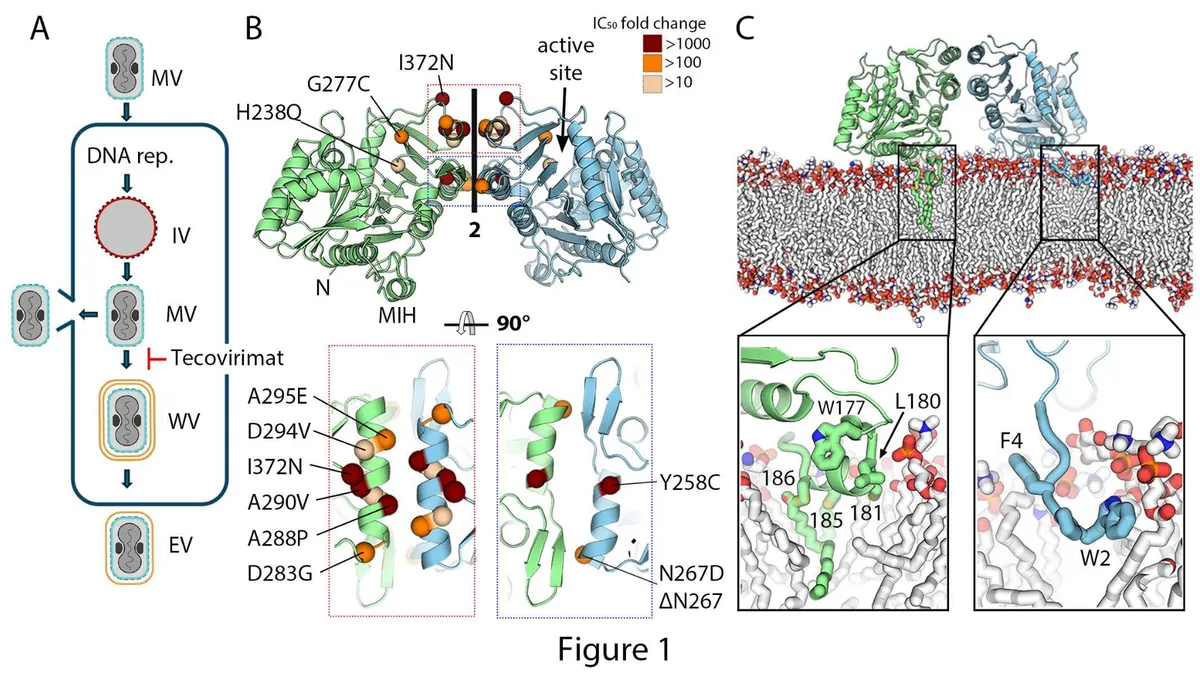
Mpox is a zoonotic disease endemic to Central and West Africa. Since 2022, two human-adapted monkeypox virus (MPXV) strains have caused large outbreaks outside these regions. Tecovirimat is the most widely used drug to treat mpox. It blocks viral egress by targeting the viral phospholipase F13; however, the structural details are unknown, and mutations in the F13 gene can result in resistance against tecovirimat, raising public health concerns. Here we report the structure of an F13 homodimer using X-ray crystallography, both alone (2.1 Å) and in complex with tecovirimat (2.6 Å). Combined with molecular dynamics simulations and dimerization assays, we show that tecovirimat acts as a molecular glue that promotes dimerization of the phospholipase. Tecovirimat resistance mutations identified in clinical MPXV isolates map to the F13 dimer interface and prevent drug-induced dimerization in solution and in cells. These findings explain how tecovirimat works, allow for better monitoring of resistant MPXV strains and pave the way for developing more potent and resilient therapeutics.
Cite
@article{Vernuccio2025,
   abstract = {Mpox is a zoonotic disease endemic to Central and West Africa. Since 2022, two human-adapted monkeypox virus (MPXV) strains have caused large outbreaks outside these regions. Tecovirimat is the most widely used drug to treat mpox. It blocks viral egress by targeting the viral phospholipase F13; however, the structural details are unknown, and mutations in the F13 gene can result in resistance against tecovirimat, raising public health concerns. Here we report the structure of an F13 homodimer using X-ray crystallography, both alone (2.1 Å) and in complex with tecovirimat (2.6 Å). Combined with molecular dynamics simulations and dimerization assays, we show that tecovirimat acts as a molecular glue that promotes dimerization of the phospholipase. Tecovirimat resistance mutations identified in clinical MPXV isolates map to the F13 dimer interface and prevent drug-induced dimerization in solution and in cells. These findings explain how tecovirimat works, allow for better monitoring of resistant MPXV strains and pave the way for developing more potent and resilient therapeutics.},
   author = {Riccardo Vernuccio and Alejandro Martínez León and Chetan S. Poojari and Julian Buchrieser and Christopher N. Selverian and Yakin Jaleta and Annalisa Meola and Florence Guivel-Benhassine and Françoise Porrot and Ahmed Haouz and Maelenn Chevreuil and Bertrand Raynal and Jason Mercer and Etienne Simon-Loriere and Kartik Chandran and Olivier Schwartz and Jochen S. Hub and Pablo Guardado-Calvo},
   doi = {10.1038/s41564-025-01936-6},
   issn = {2058-5276},
   journal = {Nature Microbiology},
   month = {2},
   title = {Structural insights into tecovirimat antiviral activity and poxvirus resistance},
   url = {https://www.nature.com/articles/s41564-025-01936-6},
   year = {2025},
}